Back
Lasers and Optical S&T

Using NIF to study the sluggish pace of star formation
Editor’s note: The principal mission of Lawrence Livermore National Laboratory (LLNL)’s National Ignition Facility (NIF) is to support the National Nuclear Security Administration’s science-based Stockpile Stewardship Program — and with the achievement of fusion ignition in 2022 at NIF, LLNL is further exploring the possible use of nuclear fusion as a future energy source…
Supercomputer simulations of super-diamond suggest a path to its creation
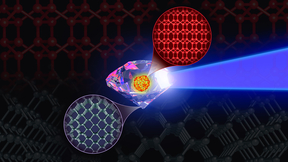
Diamond is the strongest material known. However, another form of carbon has been predicted to be even tougher than diamond. The challenge is how to create it on Earth. The eight-atom body-centered cubic (BC8) crystal is a distinct carbon phase: not diamond, but very similar. BC8 is predicted to be a stronger material, exhibiting a 30% greater resistance to compression…
Lab employees recognized with Secretary of Energy’s Honor Awards
Lawrence Livermore National Laboratory (LLNL) employees, participating in five project teams, recently earned Department of Energy (DOE) Secretary’s Honor Awards. In addition, Karin King of the Livermore Field Office was honored for her role in the Leadership in Climate Action Team. Representing some of the highest internal, non-monetary recognition that DOE employees and…
New study reveals surprising behavior of iron under extreme conditions
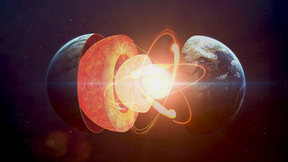
Iron is one of the world’s most abundant elements and a primary component of the Earth's core. Understanding the behavior of iron under extreme conditions, such as ultra-high pressures and temperatures, has implications for the science of geology and the Earth’s evolution. In a study conducted by a team led by Lawrence Livermore National Laboratory. researchers combined…

LLNL-led team receives DOE Award to establish inertial fusion energy hub
The U.S. Department of Energy (DOE) has awarded a four-year, $16 million project to a multi-institutional team led by Lawrence Livermore National Laboratory (LLNL) to accelerate inertial fusion energy (IFE) science and technology. This effort will be carried out by the newly established IFE Science and Technology Accelerated Research for Fusion Innovation and Reactor…
Engineering divisions provide expertise and support fusion energy’s future
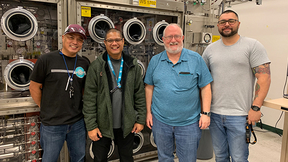
In the 2000s, Lawrence Livermore National Laboratory (LLNL) engineer Steve Hunter was asked to work on the concept for an Inertial Fusion Energy (IFE) power plant, not because of any laser or electronics knowledge that he has, but due to his firearms expertise. He needed to figure out how to inject a stream of targets into the target chamber, so that a constant source of…
Watching aluminum’s reaction under extreme pressure
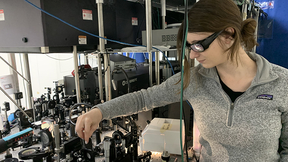
Understanding laser material interactions has applications that include inertial confinement fusion, material research and equation of state studies. Laser ablation, and specifically increasing the pressure that can be achieved from a laser system, is a longstanding topic of scientific research with implications ranging from damage in layered devices like solar cells and…
Lab researchers elected Optica fellows
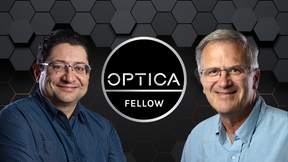
Jean-Michel “JM” Di Nicola and Peter “Jeff” Wisoff of Lawrence Livermore National Laboratory (LLNL) have been selected as fellows of Optica (formerly OSA). Fellows are selected based on several factors, including distinguished contributions to education, research, engineering, business and serving the optics and photonics community. Click here to see the entire Optica 2024…
In a first, LLNL researchers create birefringent all-glass metasurface
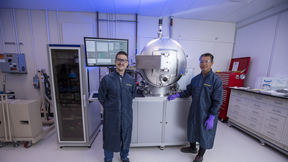
Lawrence Livermore National Laboratory (LLNL) researchers have adapted their novel metasurface process, which creates a thin layer on the surface of an optic, to create an all-glass metasurface with birefringence, or dual refraction, properties. This achievement could transform waveplate technology for high-power laser systems such as the National Ignition Facility (NIF)…
LLNL experimental physicist Alex Zylstra awarded 2023 Fabre Prize
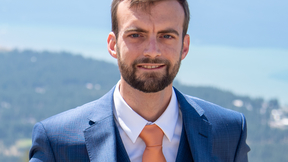
Lawrence Livermore National Laboratory (LLNL) physicist Alex Zylstra has been awarded the 2023 Edouard Fabre Prize for his experimental leadership of the milestone “Hybrid-E” campaign that achieved fusion ignition at the National Ignition Facility (NIF). The inertial confinement fusion (ICF) campaign used increased laser energy to compress deuterium and tritium (DT) fuel,…
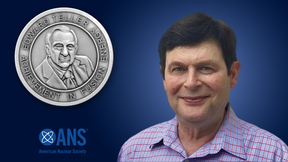
Physicist Otto ‘Nino‘ Landen receives prestigious Edward Teller Award
Otto “Nino” Landen, a distinguished member of the technical staff and the inertial confinement fusion (ICF) experiments group leader at Lawrence Livermore National Laboratory (LLNL), has been awarded the 2023 Edward Teller Medal. The Fusion Energy Division of the American Nuclear Society (ANS) presented the award to Landen this week during the International Conference on…
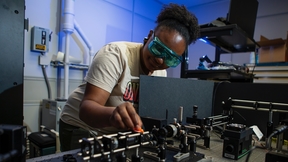
NIF&PS Summer Scholar wants to inspire other students
When Ashleigh Wilson was growing up, she thought she would become an accountant. Fast forward to the present — and the Norfolk State University Ph.D. candidate has just wrapped up her second year as a National Ignition Facility & Photon Science (NIF&PS) Summer Scholar Program intern at Lawrence Livermore National Laboratory (LLNL). “When I was a child, I really…
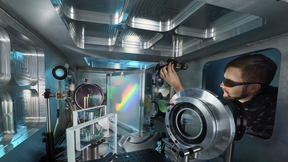
LLNL’s Jupiter Laser Facility funding renewed for additional research in discovery science
The Department of Energy’s Office of Science recently announced $28.5 million for LaserNetUS to advance discovery science and inertial fusion energy. Lawrence Livermore National Laboratory (LLNL) is one of nine facilities operating high-intensity, ultrafast lasers that will receive additional funding. LaserNetUS is North America's high intensity laser research network…

Matter at extremes: a question of scale
Scaling laws are like a secret code used across science to break down complex phenomena into simple mathematical expressions. These equations help us to understand how one factor in a system relates to other factors that determine the system’s behavior. For example, Kleiber’s Law, one of the best-known scaling laws, observes that metabolic rates of many organisms — from…
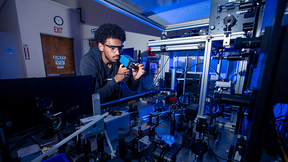
Intern follows his lifelong passion for science to LLNL
Elias Anwar, a NIF&PS Summer Scholar Program intern at Lawrence Livermore National Laboratory (LLNL), has long considered science a perfect fit for his logic-driven mind and personality. “Growing up, science has always been interesting to me,” said Anwar, who is from Northern Virginia. “It was cooler than English or history, and moving from middle school to high school…

Two Lab physicists named SPIE senior members
Lawrence Livermore National Laboratory’s (LLNL) Wren Carr and Peter DeVore have been elected as senior members of SPIE, the international society for optics and photonics. SPIE bestows the senior member designation on individuals who have distinguished themselves through their professional experience and their active involvement within both the optics community and SPIE…
Understanding the plasticity of diamond for improved fusion ignition
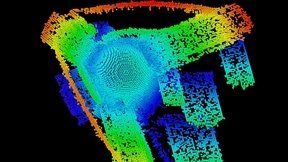
Alex Li, a Lawrence Livermore National Laboratory (LLNL) summer student in the Computational Chemistry and Materials Science Summer Institute, recently led a study published in the journal Matter to investigate the evolution of plasticity in diamond along different loading orientations and the effects that voids (pores) within the material can have on stresses within the…
NIF&PS Summer Scholar Program celebrates a record year
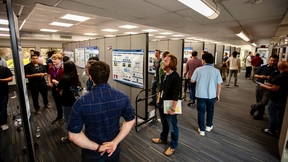
The National Ignition Facility & Photon Science (NIF&PS) Summer Scholar Program had a record year in 2023 — and the program’s director says it’s directly related to Lawrence Livermore National Laboratory’s (LLNL) fusion ignition milestone last Dec. 5. “A lot of students were excited about joining NIF because of ignition and said so on their application statements,”…
A passion for physics drives Danny Attiyah
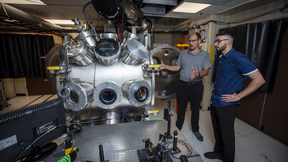
This summer, Danny Attiyah, a third-year Ph.D. student at the University of California, Irvine, will develop theory, create simulations and put those simulations to the test in a long experimental run. “I’m excited to go from theory to experimental results during my internship,” he said. Attiyah, who grew up in Southern California, was drawn to math as a student. But when…
Two LLNL scientists named Optica Senior Members
Lawrence Livermore National Laboratory (LLNL) scientists David Gibson and Paul Pax have been named senior members of Optica (formerly OSA). Senior membership status recognizes members with more than 10 years of professional experience in optics or an optics-related field. The 2023 class joins a distinguished group of scientists, engineers, entrepreneurs and innovators who…