Back
Engineering
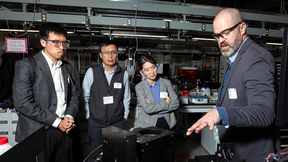
LLNL hosts Early Career Information Day focused on advanced materials and manufacturing
The University of California (UC) and Lawrence Livermore National Laboratory (LLNL) have a storied history going back to the founding of the Laboratory in 1952. The work conducted at the Lab since that time has benefited in many areas from successful collaboration with researchers and contributors within the UC system. In the spirit of continued collaboration, a UC Early…
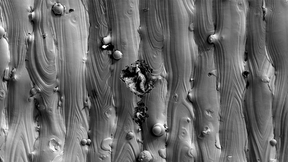
LLNL researchers uncover culprits behind pitting corrosion in 3D-printed stainless steel
Like a hidden enemy, pitting corrosion attacks metal surfaces, making it difficult to detect and control. This type of corrosion, primarily caused by prolonged contact with seawater in nature, is especially problematic for naval vessels. In a recent paper published in Nature Communications, Lawrence Livermore National Laboratory (LLNL) scientists delved into the mysterious…
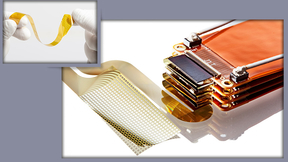
LLNL and Precision Neuroscience collaboration aims to develop next-generation neural implants
Lawrence Livermore National Laboratory (LLNL) has joined forces with Precision Neuroscience Corporation (Precision) to advance the technology of neural implants for patients suffering from a variety of neurological disorders, including stroke, spinal cord injury and neurodegenerative diseases such as Lou Gehrig's disease. Under the three-year collaboration, outlined in a…

New study reveals surprising behavior of iron under extreme conditions
Iron is one of the world’s most abundant elements and a primary component of the Earth's core. Understanding the behavior of iron under extreme conditions, such as ultra-high pressures and temperatures, has implications for the science of geology and the Earth’s evolution. In a study conducted by a team led by Lawrence Livermore National Laboratory. researchers combined…
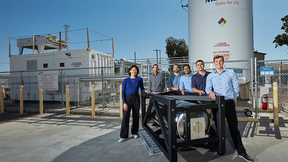
Hydrogen storage demonstrated for semi trucks
Lawrence Livermore National Laboratory (LLNL) and Verne, a San Francisco-based startup, have demonstrated a cryo-compressed hydrogen storage system of suitable scale for heavy-duty vehicles. This is the first time cryo-compressed hydrogen storage has been demonstrated at a scale large enough to be useful for semi trucks, a milestone in high-density hydrogen storage…

LLNL’s Kailkhura elevated to IEEE senior member
The Institute of Electrical and Electronics Engineers (IEEE), the world’s largest technical professional organization, has elevated Lawrence Livermore National Laboratory research staff member Bhavya Kailkhura to the grade of senior member within the organization. IEEE has more than 427,000 members in more than 190 countries, including engineers, scientists and allied…
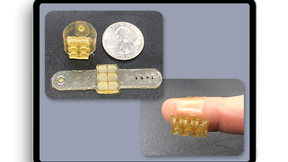
LLNL and Meta engineers develop 3D-printed material with potential for more lifelike wearables
Engineers and chemists at Lawrence Livermore National Laboratory (LLNL) and Meta have developed a new kind of 3D-printed material capable of replicating characteristics of biological tissue, an advancement that could impact the future of “augmented humanity.” In a paper recently published in the journal Matter, LLNL and Meta researchers describe a framework for creating a …
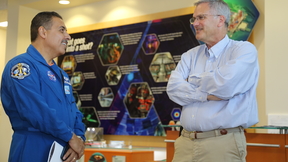
New film captures LLNL engineer-turned-astronaut’s inspiring journey
It was a chilly December night in 1972. Under a tawny half-moon hovering over California’s Central Valley, an impressionable 10-year-old boy named José Hernández looked skyward and saw his future. Hernández had spent that evening with his family as they gathered around their black-and-white television. Young José, a fan of "Star Trek," performed his usual duties as his…
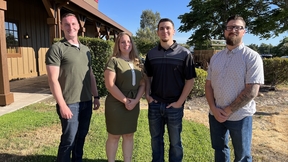
Lab’s newest machinists celebrate graduation from vaunted apprenticeship program
Lawrence Livermore National Laboratory Engineering leadership recently congratulated the latest graduates from the Machinist Apprenticeship Program at a ceremony marking their completion of the program and transition to state-certified machinists. During the ceremony, held at the traditional Cattlemen’s Steakhouse in Livermore, Lab leaders, current and former apprentices…
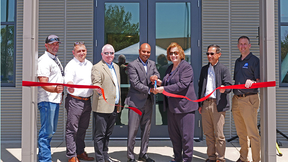
LLNL introduces Advanced Characterization and Evaluation Laboratory and manufacturing facility
Lawrence Livermore National Laboratory (LLNL) and directorate leadership held dual ribbon-cutting ceremonies on May 24, officially marking the opening of the Lab’s Advanced Characterization and Evaluation Laboratory (ACEL) and newest advanced manufacturing facility. The ACEL will serve LLNL’s Nondestructive Evaluation (NDE) group and the Nondestructive Characterization…
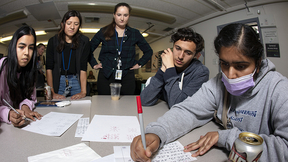
Girls Who Code ‘Altamont Connection’ brings students from Livermore and Tracy to the Lab
High school students from Livermore and Tracy visited Lawrence Livermore National Laboratory (LLNL) on May 5 for a first-of-its kind event bringing the two cities’ Girls Who Code (GWC) programs and others together on-site for group activities and tours under a new “Altamont Connection” moniker. The event, which included tours of the National Ignition Facility, Discovery…
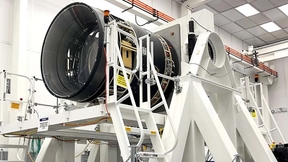
Lab engineer shares in DOE project award for work on the Vera C. Rubin Observatory
A Lawrence Livermore National Laboratory (LLNL) engineer and the SLAC National Accelerator Laboratory are among those sharing a Department of Energy (DOE) award for their roles in building the world’s newest observatory. The DOE honor, the 2021 project management achievement award, was recently presented for work done on the Legacy Survey of Space and Time camera (LSSTCam)…

LLNL’s Kamath honored as 2023 SIAM fellow
The Society for Industrial and Applied Mathematics (SIAM), the world’s premier professional organization for applied mathematicians and computational scientists, has selected Lawrence Livermore National Laboratory research staff member Chandrika Kamath as a member of the SIAM fellows class of 2023. The prestigious fellow designation is a lifetime honorific title and honors…
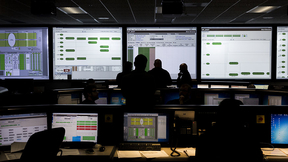
Computational Engineering is key to ignition success
In a room illuminated by blinking lights and glowing monitors, more than 2,000 synchronized computers are triggered to run 5 million lines of code. The intricate code language is responsible for aligning and firing 192 laser beams — and carrying some 800 channels of target diagnostic data — efficiently and reliably several times a day. This isn’t a scene from a science…

All eyes on Lynda Tesillo
For Lynda Tesillo, Women’s History Month means more than reflecting on the past. Her path to Lawrence Livermore National Laboratory started with studying engineering at a university — a decision which put her in a unique position within her family. “We had limited resources growing up, particularly when it came to affording an education,” Tesillo said. “At the time, my…
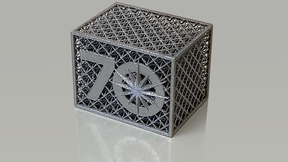
LLNL researchers develop method for real-time defect detection in metal 3D-printed parts
Lawrence Livermore National Laboratory (LLNL) engineers and scientists have developed a method for detecting and predicting strut defects in 3D-printed metal lattice structures during a print through a combination of monitoring, imaging techniques and multi-physics simulations. The high-strength and low-density properties of metallic lattices have found applications in…
‘Science on Saturday’ lecture to showcase 3D printing technologies and applications
Who: Stan Hitomi, retired educator and district administrator for the San Ramon Valley Unified School District, will present “3D Printing: From Imagination to Realization” joined by a host of Lawrence Livermore National Laboratory (LLNL) scientists, including: Eric Duoss, Julie Mancini, Monica Moya, Dominique Porcincula, William Smith, Chris Spadaccini and Becca Walton…
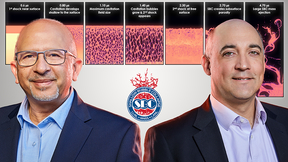
Collapsing bubbles show new ejecta production mechanism can occur under multiple-shock conditions
New research led by Lawrence Livermore National Laboratory (LLNL) provides a better understanding of ejecta production, which has been the subject of broad interest for more than 60 years throughout the scientific community. Ejecta are particles of material forced out or ejected from an area. The phenomena are observed across many multi-disciplinary applications, including…
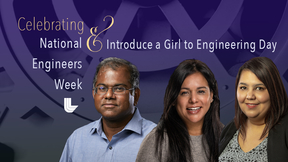
LLNL celebrates National Engineering Week/Introduce a Girl to Engineering Day
Lawrence Livermore National Laboratory (LLNL) is celebrating National Engineers Week (Feb. 19-Feb. 25) and Introduce a Girl to Engineering Day (Feb. 23) by highlighting just a few of the more than 2,500 employees that make up the Lab’s Engineering Directorate. Representing a cross-section of the broad scope of focus areas and disciplines comprising the directorate,…
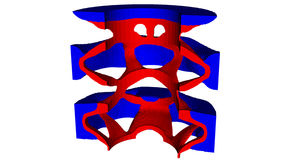
LLNL engineers make improvements to Lab-developed design optimization code
Lawrence Livermore National Laboraotry (LLNL) engineers have taken major strides towards closing the gap between the Lab’s manufacturing and design capabilities. The field of additive manufacturing, or 3D printing, has enabled the manufacturing of a variety of heretofore impossible designs — but some of this potential is left on the table because designers have had trouble…